Solar Eclipse 21 August 2017


Solar image: August 2, 2017 Questar 1/10sec          Lunar image: July 31, 2017 Questar 1/6sec

Solar eclipse on August 21, 2017

On Monday, August 21, the sun will be eclipsed by the Moon. As the Moon is seen to move in front of and across the face of the Sun, it will cast a shadow on the Earth. This shadow will be about 70 miles wide and will sweep across the United States from Oregon to South Carolina. The track of the shadow is called the Path of Totality.

Anyone inside this path will be able to see a total eclipse of the Sun, if the skies are clear. Witnessing a total solar eclipse is described as an awe-inspiring experience – the sky darkens to night as the Sun is covered by the Moon, stars and planets become visible, the temperature drops, animals and plants react as if it were night, and the Sun’s outer atmosphere (corona) becomes visible in the sky for a few minutes. At the start and end of totality a string of beads form around the limb of the Moon (Bailey’s Beads are created when the bright light of the Sun’s surface streams through the valleys along the Moon’s edge), and a spectacular diamond ring is seen signaling the beginning and ending of totality as the central bead flares out.

If you are not inside the path of totality, none of these phenomena are visible. However, in a wider band on both sides of the path of totality, a partial eclipse can be seen. In the Shenandoah County region about 86% of the Sun’s surface will be covered at maximum eclipse. The eclipse will begin here around 1:14 PM EDT when the leading edge of the Moon first blocks a bit of the Sun’s surface from view. More and more of the Sun’s surface will be blocked until around 2:40 PM EDT the maximum of 86% is reached. At this time the Sun will stand about 60 degrees above the southwestern horizon. Thereafter, the Moon will be uncovering more of the Sun’s surface again until the partial eclipse ends around 4:00 PM EDT.

It is never safe to look directly at the Sun, either with the unaided eye or through binoculars or telescopes without proper solar filters. There are various sources that can be found on the internet that can provide safe, tested solar filters for viewing the Sun. These are not regular sunglasses! There are also descriptions available for making a pinhole projection device for viewing the sun. Make certain you take the proper precautions if you plan to look at the eclipse. There is no more danger in being outside during a solar eclipse than on any other sunny day, just don’t stare at the Sun!

If you plan to photograph the eclipse, a safe, tested solar filter will be necessary for your camera.  Such a filter should be used for all partial phases.  The filter is not needed during totality (if you are inside the path of totality).  Filters can be ordered online from such places as: http://www.daystarfilters.com or any of the sources listed on the NASA eclipse site (see below).

For anyone wanting more information about the eclipse, the NASA webpage at https://eclipse.gsfc.nasa.gov/solar.html is a good place to start or any of the articles that have appeared recently in various credible news media.  There is a cool interactive map of the path of totality at: https://www.washingtonpost.com/graphics/national/mapping-the-2017-eclipse/?utm_term=.41b823a625a3

I encourage anyone who can do so to travel to a spot inside the path of totality for a marvelous celestial event. Wherever you are on August 21, I wish you clear skies!
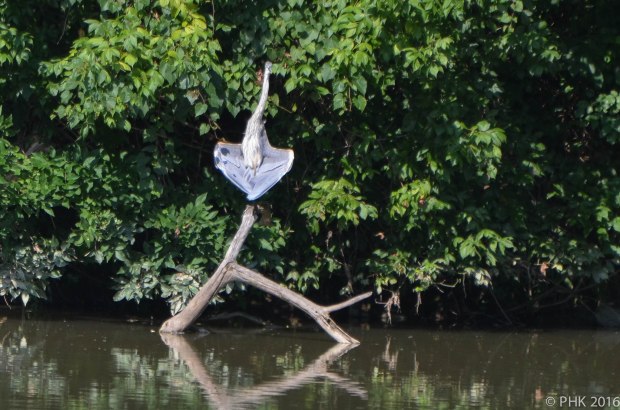
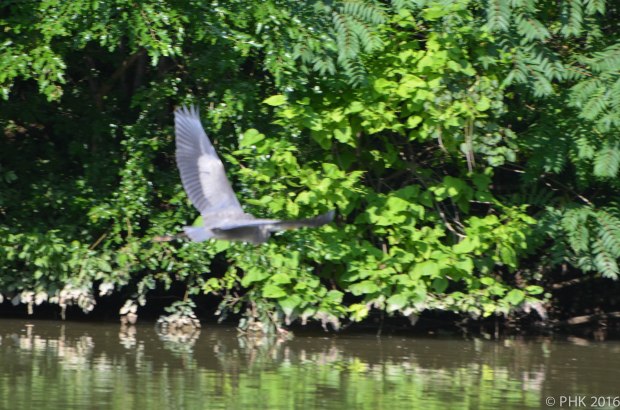
Great Blue Heron

Monday

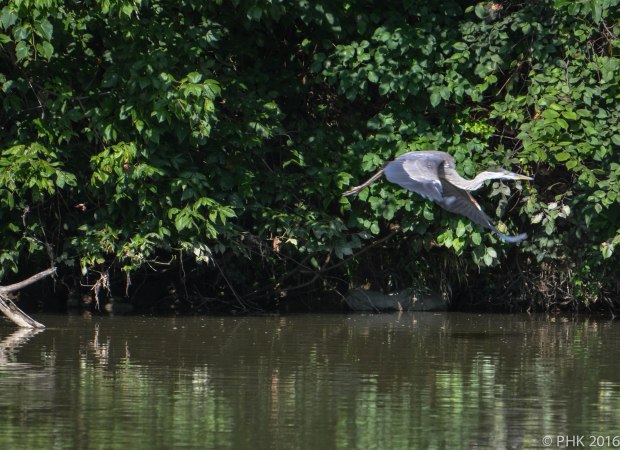
A great blue heron decided to sun itself this morning perched on a dead tree branch along the north fork of the Shenandoah River.  This stately bird was enjoying a peaceful respite from the hard rains of yesterday.

Heron 2

Then, a companion (or competitor) flew by and disturbed its solitude.

Heron 3

With its sunbathing now disrupted, he (or she?) watched as the other bird flew downstream along the river.

Heron 5

After regaining its composure the great blue heron took flight, possibly in pursuit of a rendezvous in some downstream fishing grounds.

Heron 6

These majestic birds can be seen quite frequently along the banks of the Shenandoah river.

Shenandoah Full Moon

Thursday 21 July 2016

Moon morning

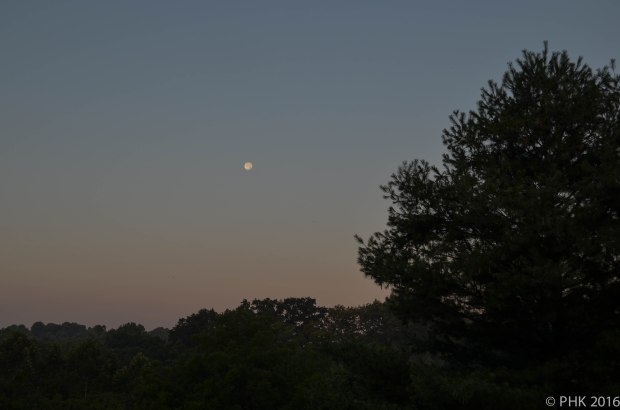
Moon over Shenandoah River treeline

In the pre-dawn sky on Thursday morning the July full Moon hung low over the western horizon above the Shenandoah River.

Full Moon 716

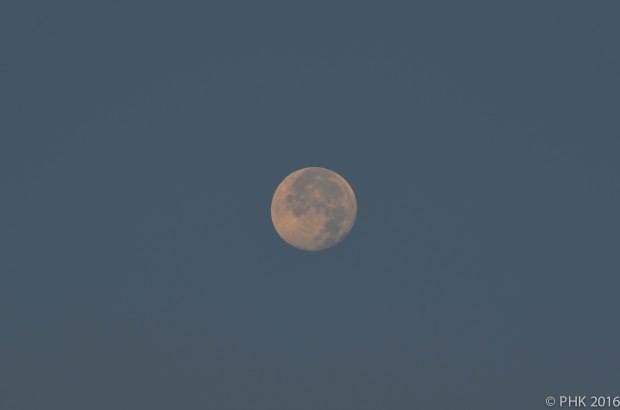
July Full Moon

A telephoto lens enlarged the lunar features including the maria or ‘seas’, the darker areas filled with basaltic lavas that cooled billions of years ago.


Route 11 north of New Market

Friday 22  July 2016

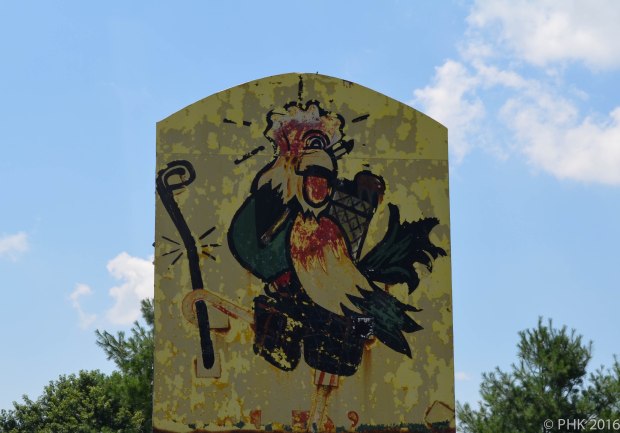
Chicken in the Rough 2

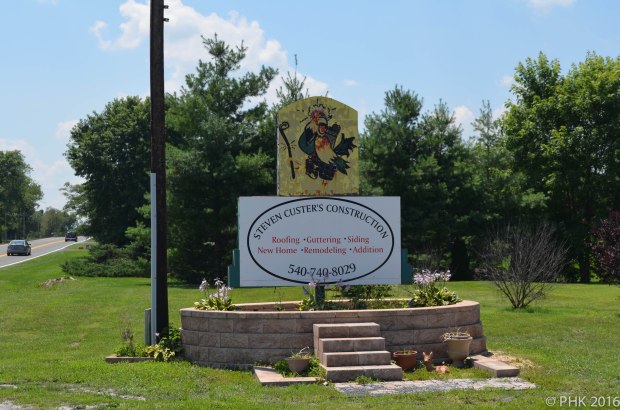
Driving along Rt. 11 between New Market and Mount Jackson a sign can be seen along side of the road with a fading image of a rooster.  On closer inspection the rooster is holding a broken golf club and smoking a cigar!  This is a left-over relic from times past.

Chicken in the Rough 1

Sign on Rt. 11 south of Mt. Jackson

Chicken in the Rough was a restaurant founded in 1936 in Oklahoma City, and featured a specialty dish of a half fried chicken, shoestring potatoes and a biscuit with honey. In 1937 the restaurant chain had locations on Rt. 66 in Arizona, Oklahoma, Missouri and Illinois. In 1949 an unusual grill was designed that simultaneously fried and steamed chicken, after which time franchising began. It was the first nationally franchised restaurant chain in the United States. During its heyday, the chain had stores in nearly 300 franchise locations, including one at M. D.’s Motel near New Market in the Shenandoah Valley.  Inscriptions on postcards like the one below

Chicken in the Rough


provide a glimpse into the Chicken in the Rough experience.

“Where you see this sign, it’s genuine fried 1/2 chicken served unjointed without silverware.  Every bit a tender  delight.  Lots of shoestring potatoes, jug honey and hot buttered rolls.”

“A $100 cash prize will be awarded to the first person who eats Chicken in the Rough in as many as 25 places listed on our placemat or carry-out carton over a period of six months.  Mail one of the Chicken in the Rough postcards, which may be obtained from the cashier, to the home office.  Each postcard must be signed and dated by an authorized person of each restaurant and Beverly Osborne reserves the right to be the sole judge in issuance of this award.”


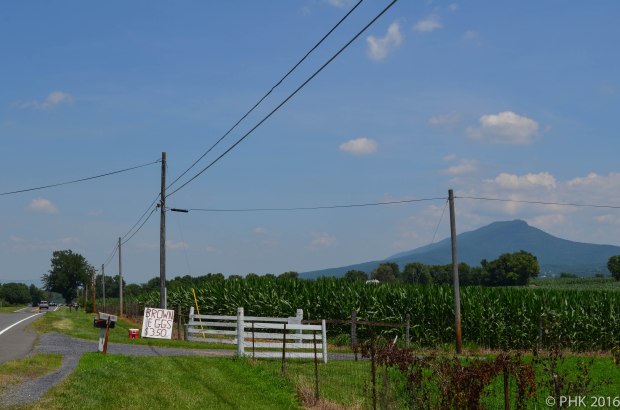
Just a short distance north of the Chicken in the Rough sign and across Rt. 11 travelers can buy a dozen brown eggs using a self-serve honor system.

Brown eggs 4 sale

along Rt 11 south of Mt Jackson

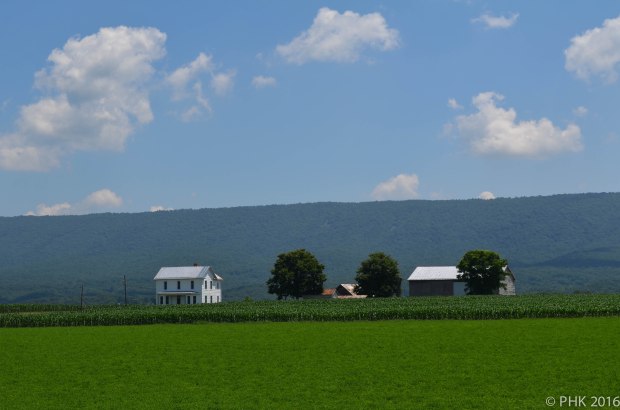
Perhaps this picturesque farm is home to the hens that supply the brown eggs.

Farm 1

Farm south of Mt Jackson along Rt 11


Skies and Gardens

Wednesday 13 July 2016

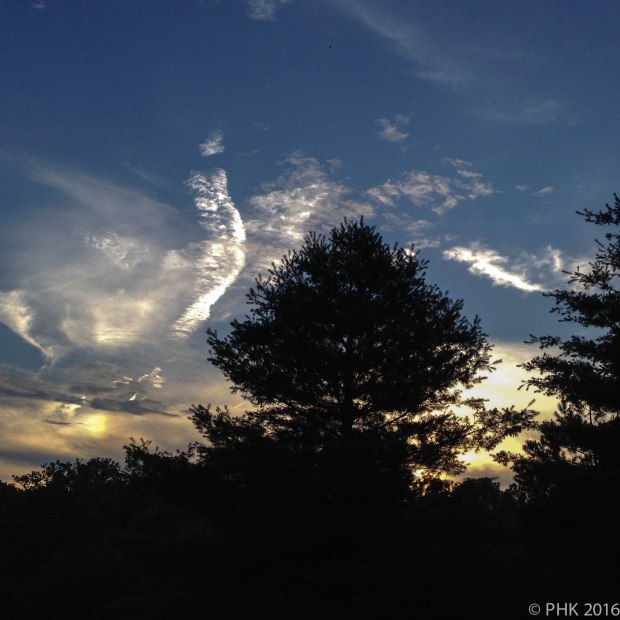
It’s a misty morning in the valley with a balmy 72F showing on the thermometer. It rained hard, but for a brief time last evening.  A brilliant sundog appeared and remained for about 10 minutes in between widely scattered storms. The sundog was visible to the south of the northwesterly sun that was fast approaching its setting position. If there was a second sundog on the other side of the sun, it wasn’t possible to see it as pines blocked the northerly view.

Sundog

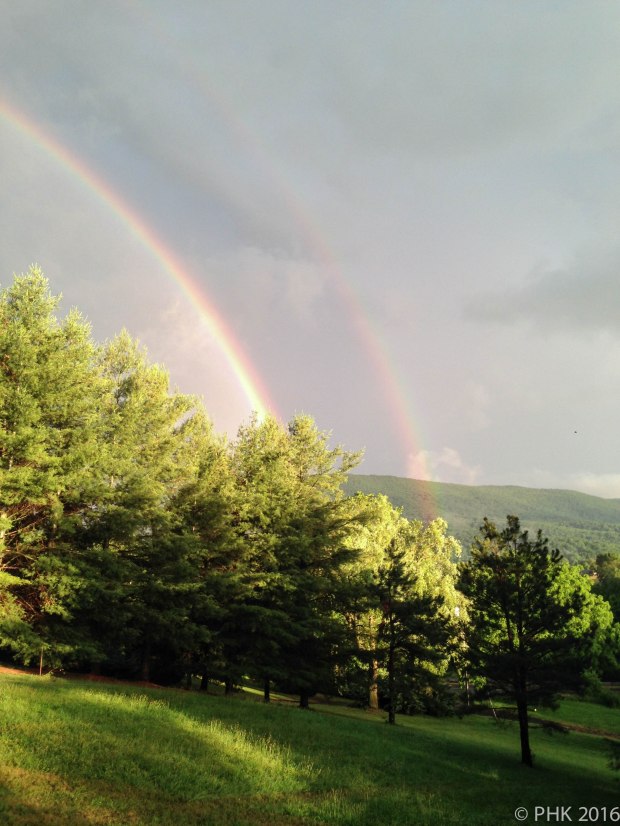
Earlier this month a beautiful double arc rainbow appeared in the southeast as the evening sun emerged from a long, hard downpour.

Double rainbow arc

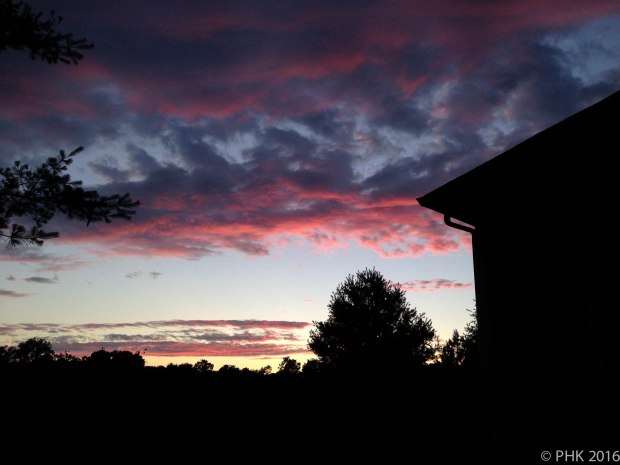
The skies have been providing quite a show over the past few weeks.

evening sky

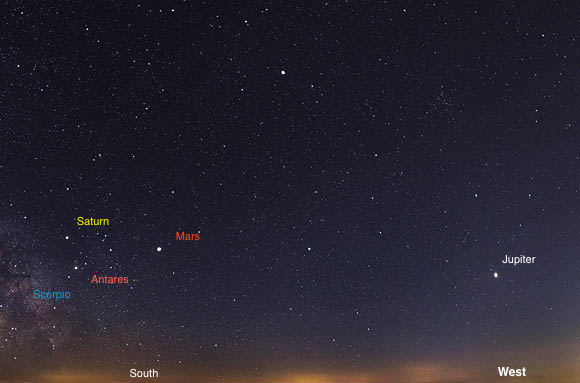
On the clear evenings three bright planets are visible and provide spectacular views through a small telescope. Jupiter dominates the western sky just after sunset, and its four Galilean moons are visible every clear evening, changing their positions as they dance around the giant planet.

Jupiter, Mars and Saturn

Mars appears even brighter than Jupiter just now, shining as a steady, red-colored beacon in the southern skies. To the left of Mars (about a fist held at arm’s length away) the yellowish glow of Saturn distinguishes it from the bright star Antares that is lower in the sky and nearby in the heart of the constellation of Scorpio. Saturn’s rings make a glorious sight through even a small telescope, seeming almost surreal. Antares (meaning rival to Mars) has a reddish, scintillating light, but this season it cannot match the brilliance of Mars. Antares is a red supergiant star, about 900 times larger in diameter and 17 times more massive than our Sun. It is a member of our own Milky Way galaxy and is about 550 light years away from us. This star and the two planets form a triangle whose shape will change slowly in the coming weeks as the planets move along their orbits.

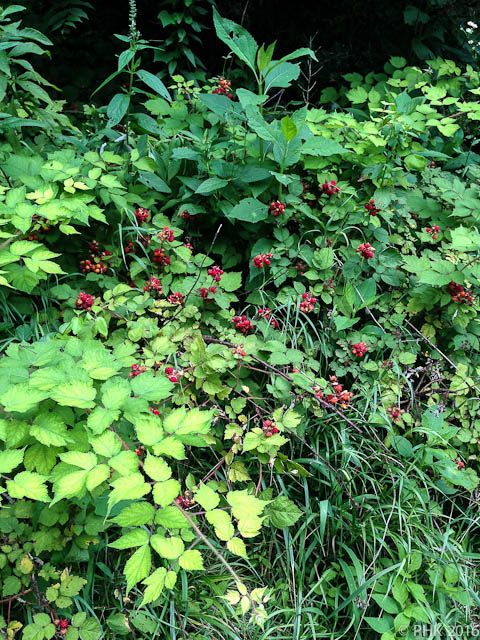
A combination of warm, sunny (mid to upper 80s) days with frequent rains (at least a day of rain each week), has provided an outstanding growing season. The grass needs mowing every 5 or 6 days, the wild raspberries are ready for picking,

wild raspberries

and the gardens are abundant with vegetables. Several large yellow squash have already been picked,

along with many juicy cucumbers.

The tomato plants are large and leafy, hanging full of green tomatoes,

and the pepper plants are loaded with green bell peppers and jalapenos.

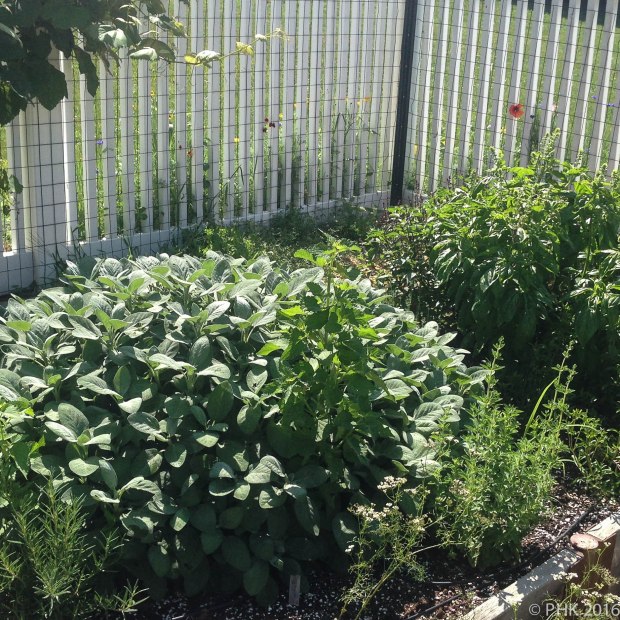
The herb bed is flourishing with sage, rosemary and thyme.

herbs

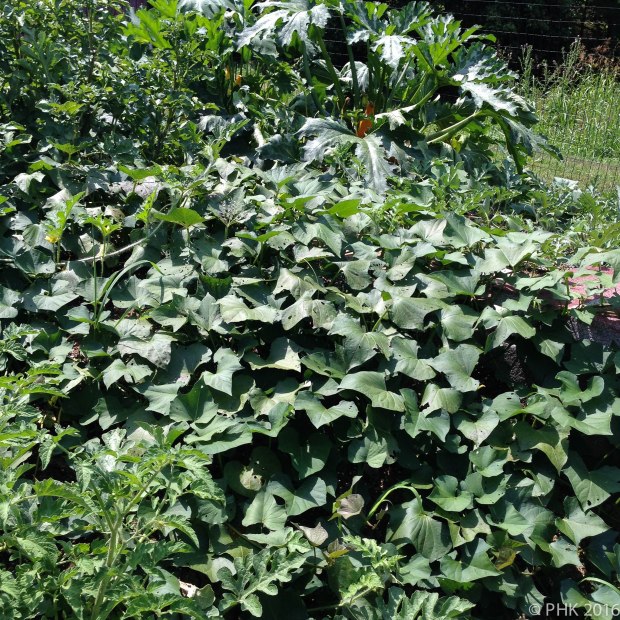
The sweet potato vines have covered half of the hugelgarten,

Sweet potato vines

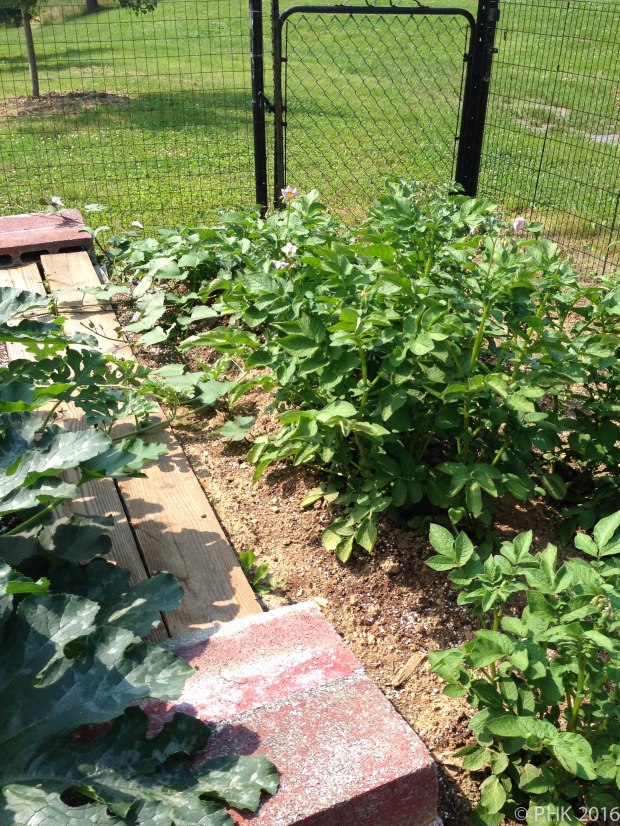
while the white redskin and purple potato plants are tall and sporting pretty pink flowers.

Potato plants

Even the watermelon vines are putting forth the beginnings of the small, round fruit that will mature into those bowling ball-sized, dark green melons that are so sweet.

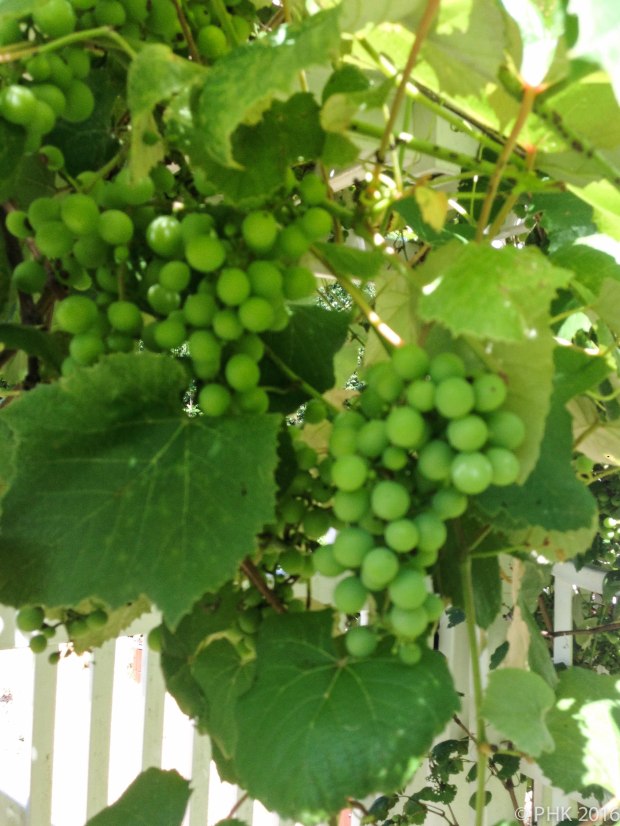
And for the first time since they were planted a couple of years ago, the grape vines are hanging full of developing grapes.

Grapes

It’s shaping up as a good year for harvesting veggies!

Exploring by Jeep

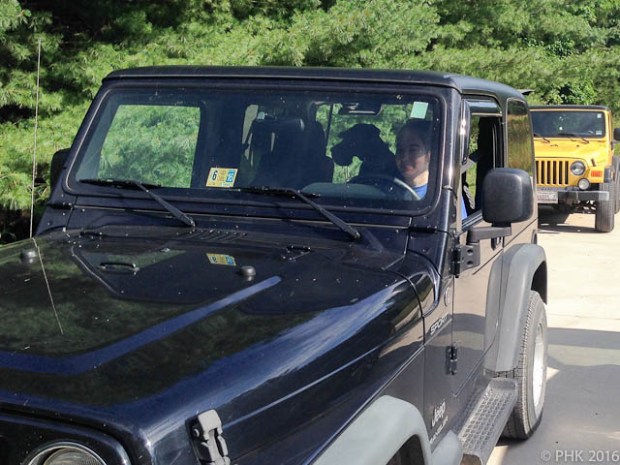
Exploring the Shenandoah Valley by Jeep is a fun way to get to know the landscape and the activities of the area. There are many gravel and dirt roads winding through the mountainous regions easily accessible by Jeep Wranglers.

Jeep tour


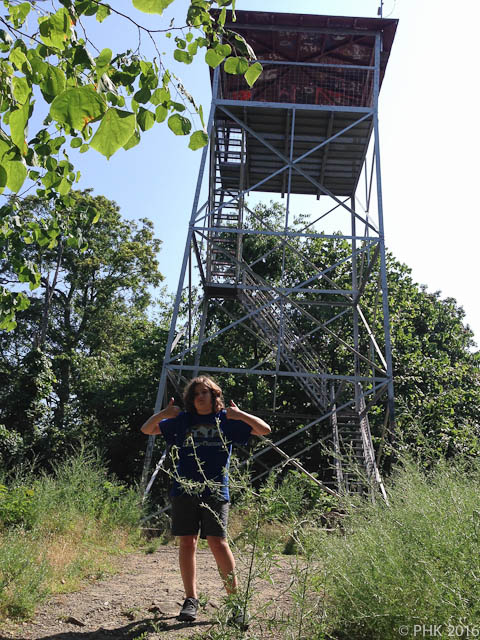
One of the ‘high’ lights of any exploration is climbing the Woodstock Tower for magnificent views west to the Seven Bends region of the north fork of the Shenandoah River.


Woodstock tower

Rain

Wednesday 11 May 2016

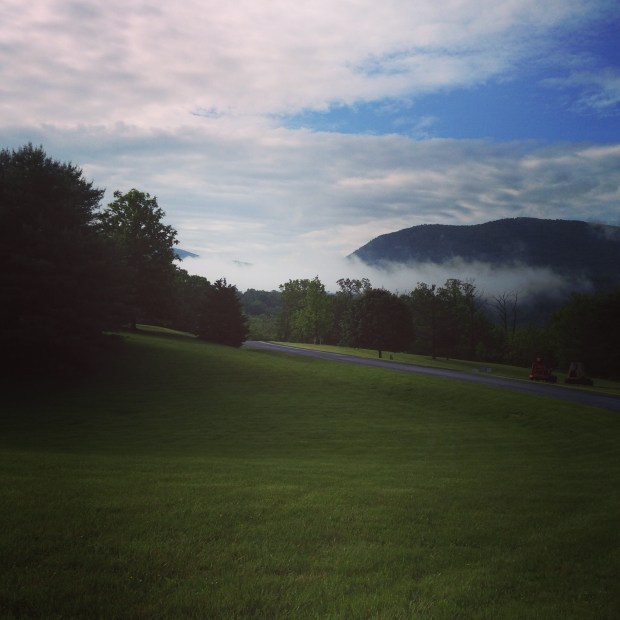
misty Edinburg Gap

It’s a misty morning here in the valley, with temperature in the mid-50s (F) and an enveloping dampness left over from recent rains. It’s been raining off and on here every day for two weeks now, with only rare glimpses of sunshine. The sun did brighten Mother’s Day for a few hours this past Sunday, and the clear skies provided beautiful views of the valleys east and west of Blue Ridge mountains in Shenandoah National Park. Skyland Lodge (mile 42) served a sumptuous brunch to hikers, sightseers and travelers along Skyline Drive.

Monday’s transit of Mercury across the face of the Sun was ‘washed out’ here by raindrops dripping from a relentlessly cloudy sky, which cleared briefly after the transit had run its 7-hour course!

The rain has been good for the newly sown grass seeds, and has boosted the early Spring growth of all of the shrubs and trees. But a few warm, sunny days would be most welcome! Short breaks from the ever-present drizzle do provide opportunities for pulling weeds and turning the garden soil over. Soon it will be time for planting the seedlings that have been started indoors.

Introduction

This website contains four sections which are updated whenever I’m inspired to do so.

Photography: images conveying the essence of the mountains and valleys, and the human imprint on them

Musings: misty morning thoughts about almost anything, along with celestial happenings over the Massanutten mountains and Shenandoah Valley.

Music: original and adapted songs and tunes

Feedback: readers’ comments, suggestions, ideas, and insights may be posted in this section.

For permission to use the photographs, writings, music or other postings found on this website, please contact the author/photographer/copyright holder at:

2015phk@gmail.com

Thank you and enjoy the site!

Paul